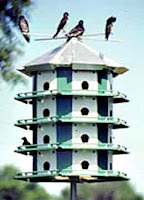
Tuesday, January 20, 2009

Purple Martin Houses


Part 4 of a 4 part series
A landlord probably cannot have too many martin houses, as most places will support several hundred breeding pairs per square mile. And, while Purple Martins live on flying insects, there is no scientific data to show that mosquitoes form a significant portion of this diet.
A colony of Purple Martins consists merely of more than one breeding pair in a given house. They are not necessarily related to each other.

PURPLE MARTIN HOUSES


part 3 of a 4 part series
The birdhouses should not be opened up until about four weeks after the first martins are scheduled to arrive in the area. The first to arrive, commonly called scouts, are not really scouts, but are merely the oldest martins. Older martins cannot be attracted to new locations, because they have high loyalty to the exact home where they bred in the past. Usually only the previous year's fledglings can be attracted to unestablished sites, and they begin returning to an area about 4 to 5 weeks after the scouts.
Bushes and shrubs growing beneath the martin house should be removed, as this attracts predators such as cats, and martins will avoid the house. Similarly, they will avoid houses which can be reached by squirrels, even by a wire.

Saturday, January 17, 2009

Bird Houses

part 2 of a part series
If any other species of bird nests in the martin house before the martins arrive, the house will not attract martins. This may involve frequent, even daily, lowering of the house to evict unwanted tenants, or plugging the entrance holes until the martins arrive.
The houses which are most successful in attracting martins are of a light color. This helps to keep the house cool in the summer's heat and highlights the dark entrance holes. Ventilation holes also keep the birds from perishing on hot days.

Friday, January 16, 2009

Purple Martin House


part 1 of a 4 part series
To attract Purple Martins to a birdhouse, the house should be placed in an open space, at least 40 to 60 feet from any trees taller than it is, preferably within a few hundred feet of human habitation. The birds need a wide space to approach the house from at least two sides, and they seem to know that people will protect them from their natural predators. The activity of people does not seem to bother them at all.
The house should be mounted 10 to 20 feet off the ground, preferably on a telescoping pole so that it can be lowered for easy cleaning and for checking on the young in the nests. A predator guard on the pole is also highly desirable. The house should not be moved, once martins have taken up residence in it, as they will reject it the following year if it is in a new location.

Wednesday, January 14, 2009

CHERUB BIRDFEEDER


Many statues or sculptures serve dual or even triple purposes. If you are decorating a small backyard, you may want to consider these features. Fewer objects rather than more will keep the area from looking cluttered and still give you what you are looking for.

Tuesday, January 13, 2009

BarnWood Rustic Barn Birdhouse


Blending into the farm scenery is this quaint birdhouse. It is actually quite a picturesque birdhouse and very reminiscent of days gone by.
Our little feathered friends need our help. Such a small task for us but a huge deal for the birds. It is getting harder and harder to find shelter and a place to rest as they move about from place to place.

Monday, January 12, 2009

Flashy Hummingbird Feeder


Who among us isn't fascinated seeing a hummingbird? They are truly miraculous. Of course all birds are when you consider flight.
Hummingbirds can literally hover motionless in one spot while they sip the nectar from their favorite flower or from your feeder. They are truly spectacular to view.