Showing posts with label birds. Show all posts

Thursday, April 8, 2010

Decorative Birdhouses


It turned a little cool today and there is talk about another snow. Do you know the old saying about there will be three snows after the forsythia blooms? Well we have only had two snows, so if the saying is true we're in for another snow. Then we'll have warmer temperatures that will stick around through spring, summer and fall. But until them the little birds that come our way will have a place to stay. They will be out of the weather in a dry home of their own. They won't be bothered by the wind, rain, or snow. Do you have birdhouses for you feathered friends?

Monday, April 5, 2010

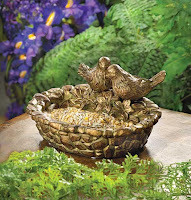
Bird Cafe Birdhouse


I have surely missed hearing the birds sing. At last the last few days with the warmer temperatures the birds are coming back! I sit on the porch and listen to them call and sing to each other as they flit about looking for materials to build their nests. I love the decorative birdhouses and have several. Are you a fan of backyard birding?

Wednesday, November 4, 2009

Birdhouses and Birdfeeders


Whether you hang birdhouses or birdfeeders or both really is just your preferences. Birdhouses will offer shelter from the heat, cold, wind and rain, while the birdfeeders will feed them. If your goal is to learn more about the birds that frequent your premises I would advise that you hang both. You also might consider planting trees, bushes and a variety of plants that will specifically lure the birds in.

Saturday, October 3, 2009

Birds are hungry


Birds are hungry. We all know that birds can survive without our help, but feeding them does help us both. Some ornithologists have even suggested that bird feeding is more beneficial to humans than it is to the birds. Studies have shown that birds with access to bird feeders in winter survive at a higher rate than birds without access to feeders. Feeding birds in winter is a good thing for the birds. If you live where there is winter weather , a blast of wind and snowy weather will mean making an extra effort to keep the feeders going for the birds.
Here are some ideas to help you prepare your feeding station for the worst of weather. Be prepared to have plenty of seed, suet and peanut butter on hand. You might place some dried grass or wood shavings in the bottom of your wood birdhouses. You could even cover the vent holes with some weather stripping (the birds won't need this source of air in the winter). Some birds are ground feeders, so you'll want to be sure there is an area that is clear of snow so you can sprinkle seeds on the ground.

Tuesday, August 4, 2009

Barn Swallow


Barn Swallows breed from Alaska across Canada, throughout the United States, and south through central Mexico. With the proliferation of human-provided nesting sites, the North American Barn Swallow population has increased in most places during the 20th century. Numbers are especially up in the central and eastern United States. Barn Swallows show strong fidelity to their natal site, most nesting within 20 miles of their birthplace and some much closer. Members of a pair typically stay together to raise a second brood and return in successive years to the same nest site. If you have the right habitat, barn swallows are easy to attract. A simple nesting perch may be placed under the eaves, inside a garage or barn, or on the side of a building.

Thursday, July 30, 2009

Gold Finches


To encourage goldfinches into your yard, plant native thistles, sunflowers and other composite plants, as well as native milkweed. Almost any kind of bird feeder may attract American Goldfinches, including hopper, platform, and hanging feeders, and these birds don’t mind feeders that sway in the wind. You’ll also find American Goldfinches are happy to feed on the ground below feeders, eating spilled seeds. They’re most attracted to sunflower seed and nyjer, which is a thistle seed.

Monday, June 22, 2009

Backyard Birds


The most amazing thing, I think, about birds is their ability to fly. As you watch you'll notice that each species has its own way of maneuvering about. For example a crow flies petty staight (you've heard the old saying about directions "as the crow flies", while a sparrow is very erratic in its flight. The sparrow twists and turns staying close to the bushes because it is very vulneralbe to being attacked.
As you start watching the birds is your backyard you'll begin noticing some of their habits and patterns. Like when they arrive in the spring, when they begin nesting, when a storm is brewing and when they begin to migrate. It is really very fascinating. What kind of birds visit your backyard?

Friday, June 19, 2009

Dead Tree Stumps


Almost everyone that has had a tree taken down wants to remove the stump. They claim it to be unsightly. But what if you only had the tree top portion removed leaving several feet of the trunk standing? It could become quite a focal place in your backyard. Did you know that this would be one of the greatest attractants you could have in your garden? Not only will it attract birds for nesting holes, it will provide a great banquet table for the birds. I will also be a great birdwatching spot.

Wednesday, June 17, 2009

Decorative Barnwood Chalet


Weeds, an interesting thought, to say the least. Did you know that the number one attractor for birds is the number bane of gardeners? Yes it is the weed! The Bur Marigold, Dandelion, Ragweed, Pigweed, Lamb's quarters, Mulletin, Goldenrod, Dock, and Jewelweed are great for attracting birds. Hummingbirds love the blossom of the Jewelweed and Rose Breasted Grosbeaks feast on the seeds. With a little expert help you can pick and choose which Weeds will be best for your garden.

Sunday, May 31, 2009

Titmouse Houses


The Plain Titmouse is the western cousin and lives in the southwestern states. It is a small, gray bird with a crest, but it is all gray, without the rust or white accents.
Both birds hunt for insects by clinging to branches of trees and shrubs and peering into the crevices of the bark. They sometimes forage on the ground as well.
Their calls are similar, a whistled "peter, peter, peter."

Wednesday, May 20, 2009

Golden Gilded Birdfeeder


It isn't too late to add birdfeeders or birdhouses to your garden decor.
Your garden visitors will like the royal treatment with this luxurious feeder! Burnished gold finish lends luster to a sculpted dish trimmed with doves and lilies; The deep bowl holds a generous amount of seed fit for any feathered king. This birdfeeder will add a bit of sophistication to yourbackyard scenery!

Thursday, April 30, 2009

You Can Lure Specific Birds


Did you know that you can lure specific birds to your backyard, like Cardinals, Bluebirds, Thrushes, Sparrows etc. You'll be the envy of neighbors having a chorus of songs like no other. It all has to do with the habitat, and the food.
For example, Sparrows like a meadow garden, a weedy field or a patch of prairie flowers. They really don't care for a "woody" area. You will be providing an area to nest as well as food they like.
After checking sources for the types of birds you like you will be better able to provide for them. What are you favorite birds?

Sunday, April 26, 2009

New Life Begins


What a glorious morning!! It is so nice to wake up with the sun shining, the birds singing and a cool breeze blowing. Spring is one of my favorite times of the year. Everything is greening up, flowers are beginning to bloom, robins and other birds are beginning to show up as they return from their winter retreat. These are sure signs of life being renewed. It won't be long before we can witness new life as the eggs in the nest hatch. Do you feel as blessed as I?

Thursday, April 23, 2009

Its a Great Day


Good Morning. The sun is shining and a great day is predicted....in the 70's. Boy have we been waiting for that!! And judging by the birds singing so have they. Do you have your bird houses and bird feeders ready and waiting for them. The birds will be searching for a nice place to nest so they can prepare for their new families.
It is so much fun watching the progress of the birds, building their nests (whether they are in a house, bush or tree) then watching the eggs, waiting in anticipation for them to hatch, then watching the hatchlings to an adult bird. And what an education for your young children or grandchildren.

Tuesday, April 14, 2009

White Doves


Did you know that doves are members of the pidgeon family? They also make great pets . Doves are actually very gentle and they tend to adopt to a family. They will set with family membets or a personal object belonging to a family member.
Doves are also very inexpensive. They are quite charming birds and it is fun to watch their little antics and the different "coos" that they have. They actually have rituals that are fun to watch . Doves require very little. Given fresh food and water they will do quite nicely.

Saturday, April 11, 2009

Finally It's Spring!!


Well it is finally Spring, and you will see more and more birds. Wouldn't it be nice if they were in your backyard? It is possibe. All you need to do is put up a few birdfeeders and birdhouses to attract them. It also helps if your backyard is bird friendly. Trees and bushes will help them to feel safe as they move about. Water features such as ponds, streams and /or birdbaths will also help.

Thursday, April 9, 2009

Have a Happy Easter


It's Easter and it is soooo tempting to purchase live chicks and bunnies for your children and grandchildren. But, please reconsider. They really are not good pets for young children! Children want to play and handling these young animals so much is not good. In fact too much handling can cause stress for them and they could die, and this in turn causes stress for the child and you. It's a vicious circle.

Saturday, April 4, 2009

Did You Ever Wonder....


Did you ever wonder how baby birds seem to stay in their nests without falling? Baby birds spend about 14 days in their nest, so what is it that keeps them from falling? Well they are born naked, featherless and are very squirmy. Fledglings will have stubby wing feathers and their tail feathers will be about half grown. As they change from a hatchling to a fledgling they have a very heavy bottom. This serves a purpose to keep them securely weighted in their nest.

Monday, March 30, 2009

Chickadee's


The Mountain Chickadee or Poecile gambeli has a white eyebrow through its black cap and lives in and west of the Rocky Mountains, where he calls chick-adee-adee-adee. The Chestnut-backed Chickadee has a chestnut-brown back and a brown cap and lives in the northwest and along the California coast. His call is more of a tseek-a-dee-dee.
The Black-capped and Carolina Chickadees like mixed forests, open woodlands and suburban areas, while their western cousins prefer coniferous forests.
Chickadee belong to the titmouse family. They are largely an insect eaters, but in winter they may depend greatly on seeds and berries. They are adept at foraging for insect eggs and larvae from twigs and bark, and this accounts for their active hopping and climbing around on trees to spot their food from all angles! Their favorite foods at feeders are sunflower seeds, peanut kernels, other nutmeats, peanut butter, and suet.
In the non-breeding season chickadees tend to flock together, and sometimes the flock may even include titmice, kinglets, nuthatches, and other birds. During breeding season, the males will drive others out of their territories, so you may have only one pair of chickadees in your yard, where you may have had a flock all winter.
From the beginning of courtship through the period of egg incubation, the male chickadee feeds the female. They typically raise one or two broods a year of 6 to 8 young and are year-round residents.
Since chickadees' natural means of nesting is to excavate a hole in a rotting tree, you may make your nest box more attractive to them by putting a little sawdust or wood chips inside it for them. They will not use it for nesting, but since they usually work in pairs to carry a little sawdust away from the hole they are making in a tree, they will perceive that this hole in a tree is appropriate for them, and they will carry the sawdust away before nesting there.
Chickadees move to denser woods for breeding and nesting, but the rest of the year they like open areas and forest edges.

Tuesday, March 24, 2009

Wren Feeder


Are you a true bird lover? What do you think about this feeder? I think this is a wonderful idea! It is fun to be outdoors and watch the birds, but this is the ultimate. You can be sitting in your living room and the birds will come in to your room. Well almost. This way you can see them up close.